
Translating Principles into Practice for Systemic Equity
Purpose
To offer a replicable, values-led model that enables organisations to move from aspiration to implementation in tackling systemic discrimination — centred on human rights, equity, and accountability. This model can be used across professions and organisations.
An implementation model can determine success because it transforms vision into structured, actionable steps that drive real-world change. Without a clear framework, even the most principled commitments to equity, human rights, or inclusion risk remaining performative or fragmented. A well-designed model ensures that action is intentional, accountable, and measurable, anchored in values but responsive to lived experience and systemic barriers. It also provides consistency, enabling leaders and organisations to test, learn, and adapt while staying focused on long-term outcomes. In essence, an implementation model bridges the gap between what should happen and what actually does.
Organisations can also standardise implementation models (for example using the one below) to ensure comparative testing across functions and data capture. It also provides a standard against with staff can work to.
Foundational Principle: Human Rights as Practice
Rather than a legal afterthought, human rights become the core method by which decisions are tested, outcomes are shaped, evidence is tracked and people are centred.
We define implementation success as action that:
– Advances the dignity, autonomy, and rights of all people
– Centres those most marginalised
– Actively prevents harm and enables remedy
– Embeds transparency, participation, and accountability
The Model
- Core drivers (Human Rights Framework)
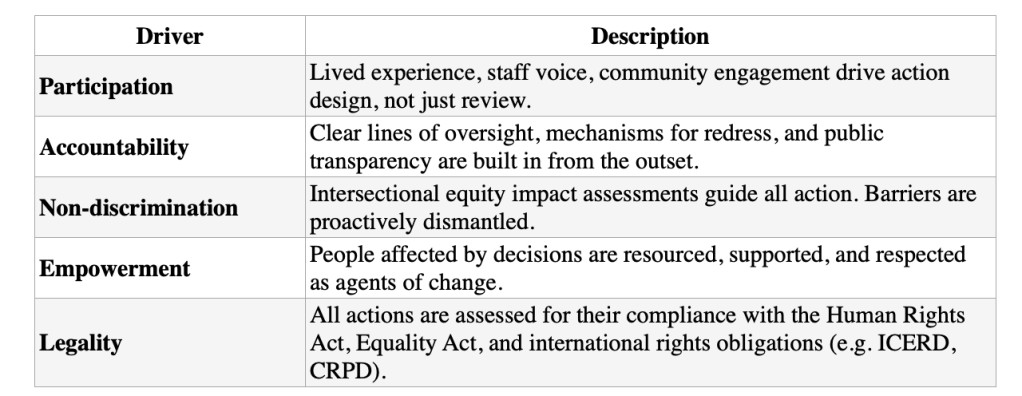
Implementation pathway
A. Define the Rights-Based Aim
What rights are engaged? (e.g. Article 8 – right to private life; Article 14 – non-discrimination)
What systemic breach or inequity are we addressing?
What change would reflect restoration of rights?
B. Assess the Systemic Context
Use data, lived experience, complaints, research
Ask: What patterns show structural harm? Who benefits from the current state?
C. Co-Design Actions
Build cross-sector panels with those with lived experience
Develop actions collaboratively — not in silos
D. Build in Human Rights Tests
Every recommendation/action is reviewed for:
Disproportionate impact?
Remedy or reinforce power imbalance?
Capable of advancing equity and legality?
E. Pilot with Purpose
Pilot in one area or setting with accountability measures
Document barriers, enablers, and unintended consequences
F. Adapt, Scale, Embed
Use pilot data to revise
Develop sustainability tools (toolkits, training, governance templates)
Embed into leadership KPIs and commissioning frameworks
Strategic enablers
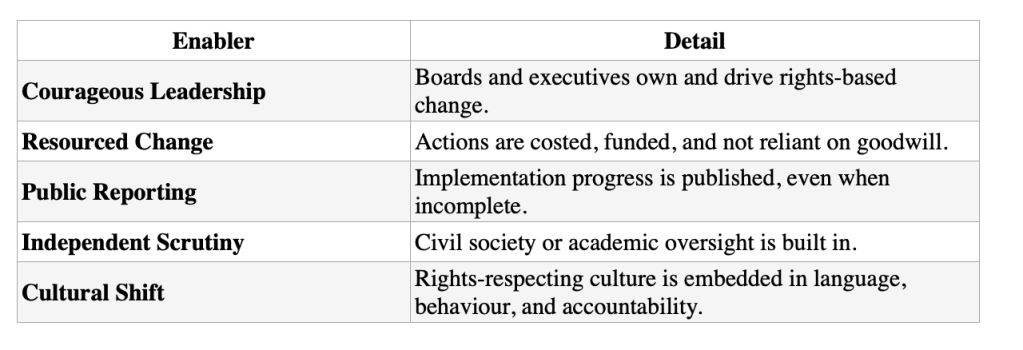
Outcomes
Short-Term:
– Transparent goals, action plans, and timelines
– Inclusive and empowered processes
Medium-Term:
– Measurable reductions in inequity
– Embedded governance change
Long-Term:
– A system that enacts human rights in practice — visible in lived experiences, not just policy
Looking Forward: Integrating AI into a Human Rights Framework
Currently, technology is reshaping public services and integrating AI into human rights-based implementation models. Equity must still lie at the heart of how technology is used to enhance the quality of life of people using services and delivering the services. It should be said that AI has the potential to accelerate equity by identifying patterns of discrimination, improving decision-making transparency, and streamlining data-driven accountability. However, it also carries significant risks: if ungoverned, it can reinforce existing biases, erode trust, and automate structural injustice. Looking forward, AI must be integrated into the framework not as a neutral tool, but as a domain requiring ethical oversight, participatory design, and legal safeguards that are framed around human rights and centre equity. Embedding AI governance within a human rights-based model means ensuring that algorithms are auditable, equitable, and aligned with principles of non-discrimination (for example including anti-racism and the principles of anti-racism) empowerment, and legality, so that technological progress serves justice rather than undermining it.
 King Advisory
Leave a comment